Friday, September 09, 2011

Future Visions of Transportation

A long-time fan of science fiction novels, short stories and films, I grew up reading authors like Orson Scott Card, Robert A. Heinlein and Isaac Asimov, the author of the short story I, Robot. 


Recently, I had the chance to see the 2004 film adaptation of the short story, starring Will Smith and Bridget Moynahan. Although the film simplified many of the intellectual subtleties of the story and added predictable amounts of Hollywood action, I still found the movie to be enjoyable. I am a fan, after all.


The film I, Robot is set in the Chicago of 2035 and although there is at least one scene with the familiar elevated railway, all of the characters seem to prefer travel on freeways in private vehicles that appear to clock speeds well over 200 mph, all controlled by computers for safety and efficiency. However, the main character, Del Spooner, played by Will Smith, has a tendency to override the computer control and take manual control of his uber-cool 2035 Audi (product placement, please).


One of the most memorable action sequences in the movie involves Del being attacked by homicidal robots while hurtling down the futuristic freeway.


To survive, Del takes manual control of the car from the traffic control system (a frequent, if discouraged, practice for the main character), ensuring that he can perform the necessary acrobatics. This idea of individual control versus centralized control is a key theme in the film. And, in the context of the movie-action heroics, we discover a particular viewpoint of the future of urban transportation, especially in the United States: 

[a] that technologically advanced private vehicles on technologically advanced superhighways are preferable to public transit and 

[b] that efficient, computer sequenced highways are ok for the masses, but sometimes you have to "take the wheel" for individual expression or basic survival. 

In other words, even the barest nod to public-spirited transportation found in computer-controlled traffic control is not to be trusted (just like those damn robots.)


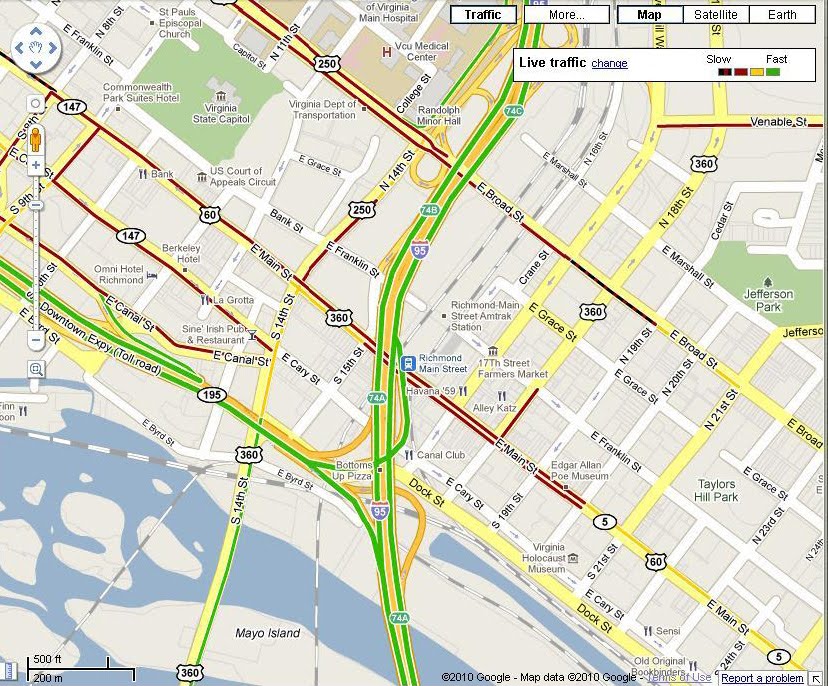
If the science fiction genre allows the positing of trends, what is being said about the future of transportation in our cities? In the case of I, Robot, the message seems to be that the largely car-centric culture of the United States will continue to evolve into faster, more efficient private transportation that reinforces an identity of hyper-individual liberty. At what cost? If today's freeway cloverleaf takes more land area than medieval Florence, how much land will be required for 200 mph turns?


[Source: Google Earth]


As a contrast, what alternatives could a near-future science fiction propose for public transit in the United States? Is there an alternative that promotes public transit as an integrated way of life? What other near-future depictions of transportation do you remember from films? Leave a comment...

Friday, September 02, 2011

First Friday Sketches - September Edition

Today we sketched from Jefferson Park at the edge of Union Hill. Enjoy.


 John Spain

 Andrew Moore

Lori Garrett

Wednesday, August 10, 2011

How to Climb a [Church] Hill

At the north east corner of 21st Street and East Franklin is a steeply sloping hillside, known as Taylor's Park Hill. It is, in fact, a public park and the foot of the Church Hill neighborhood. At the top is a spectacular panoramic view of downtown Richmond. 
This hillside corner is a dramatic boundary between Church Hill and Shockoe Bottom and for as long as I have been in Richmond, the most direct way to cross the boundary was to climb the steep concrete stairs. 
The stairs traversed the terraces of the slope and partway to the top, there was a paved walkway that followed the slope up to the right. At the very top, there was a muddy, overgrown path to the left that led you to the overlook. Neither path was easily accessible or used very often.
Then, a couple of weeks ago, heavy equipment began excavating the hillside to install large storm water pipes, demolishing the existing stair in the process. 

Immediately following the pipe installation, the contractor began recreating the demolished stair, a monumental construction task.
This begs the question of whether the stair should be simply recreated in its little-used, difficult-to-negotiate original form? Was there an opportunity for design that was missed? Building any stairway in this location is a significant (read "expensive") feat of construction. Could there have been a grander vision?


Surprisingly, there is actually a site devoted to public stairs and the Libby Hill Stairway makes the crowd-sourced list. The Taylor's Hill Park Stairway is at least as significant as Libby Hill.(Incidentally, The Libby Hill Stairway also appears to be a recently recreated project following the preexisting pattern.) 


Perhaps a "Church Hill Steps" would be the wrong scale...
[Spanish Steps, Rome; www.earthinpictures.com]
...but Taylor's Hill is a notable connection within the urban fabric and worthy of celebration. Instead, it appears that we will get a shiny new version of what was there before. Maybe the muddy path will be improved...

Thursday, July 28, 2011

Tips for a Better Boom Boom Burger

Back in May, I penned a piece on the demise of Boom Boom Burgers, the innovative yet ill-fated burger joint that lasted six months in Shockoe Bottom, and how the owner's reasons for the failure didn't hold up to scrutiny.


During a recent visit to Atlanta, I was delighted to stumble across Yeah! Burger and was immediately struck by the ways YB was superior to Boom Boom despite having a similar intent (local, organic, high-quality burgers).


1. Location, location and yes, location. YB is located on a highly visible, heavily trafficked (pedestrian and vehicle) corner in Virginia Highlands. The seating is plentiful and includes an enclosable patio (see and be seen). It is not hidden on a side street.


2. Menu. Simple and complete. Pick your patty (all natural, grass fed, organic, including a vegetarian option), choose your bun (including a gluten-free option), add toppings and fill it out with sides (including multiple varieties of fries, onion rings and other great stuff). Plus, YB has a kick-ass selection of beer, wine and spirits. Finish with ice cream. Check it out here.


3.Value. The portions are generous and despite the fact YB isn't cheap (a meal is going to cost $10-$12 minimum), the great food plus great atmosphere makes it seem worth the money. And YB accepts all normal forms of payment including (gasp) cash.


So, Boom Boom take note. There is a better way.

Tuesday, July 05, 2011

Diamonds in the Rough


Patrick Dougherty's work "Diamonds in the Rough" at the Lewis Ginter Botanical Gardens is called a sculpture, but it's really a fine piece of architecture. As soon as my children saw it, they ran to it and entered its maze, which seems to go on and on even though the piece occupies a relatively small site.
Timeless and slightly witchy, the twisted sweetgum and maple structure invites one to wander quietly through its chambers, randomly encountering others who are similarly drawn. There is a faint, dry, woody smell which recalled for me the notion of ancient libraries, repositories of arcane knowledge. Everyone I saw there felt compelled to touch the stems, taut and growing more rigid as they dry in the sun.
The piece is not permanent, the artist will take it down before it crumbles. Some of the volunteers seem to have an interesting idea - a bonfire (with the fire department close at hand, of course.) So see it soon. And often - it should be interesting to see how it changes over its life of a year or so. The patches of maroon-brown leaves in the walls, like crumbling parchment may gone soon, that's my guess.
There are more details, photos, and a timelapse video of the construction at the Lewis Ginter Botanical Garden's website.

Monday, June 20, 2011

Everything Spreads Out


Paradise Drive, begins with a description of a drive through the urban-to-rural transect of an American city, starting with the downtown "urban hipster zone" and ending in the exurbs, the domain of Patio Guy and Realtor Mom. Often riotously funny, David Brooks' narrative on Middle American culture is freewheeling and painfully insightful. One of the most piercing chapters, "Working," skewers the pop business world of motivational speakers and bestselling books, such as Who Moved My Cheese?. Brooks fantasizes that he might have been Ray Croc, creating a motivational empire around "Find Your Fry! Follow Your Fry," ultimately shortened through loving familiarity to Fry!. Good stuff.

Perhaps the most insightful proposal Brooks makes in the book is that the American suburbs are a reflection of a peculiar cultural phenomenon - finding new geographic space for personal interests. If you don't like your neighbors, find some you like and move there. This leads to the characteristic dispersal of the suburbs and exurbs, with the penultimate example being the gated community. Contrast this with the historical association with Place that is typical of urban life. If you consider your identity to rooted in a particular Place, then the motivation to resolve cultural tensions exist in situ. Certainly, there are innumerable enclaves within any city that cater to particular (and peculiar) tastes and people choose to locate and relocate according to those interests. However, these choices are exercised within the hierarchies of existing city fabric, not through dispersal. Furthermore, cities foster the idea that my Place is worth fighting for - the cause of much tension, both creative and destructive - but reinforcing the sense of Place nonetheless.

The psychological, sociological and cultural isolation that result from the suburban lifestyle has been widely discussed. Inverting the discussion, Brooks suggests that a culture of deliberate, cellular dispersal is reflected and empowered by the suburbs.

Tuesday, June 07, 2011

A Back Room Deal for City Property?


Buried in the Code of Ordinances for the City of Richmond is a curious provision that permits the City to dispose of property in response to an Unsolicited Offer.

 The curious aspect of this provision is that only two conditions must be met for the sale: (a) that the Mayor recommends the sale through crafting an ordinance for City Council consideration and (b) the passage of that ordinance by City Council. That's it. No additional due diligence measures, property valuation to establish a fair price, or introduction of competition is required by the provision. Furthermore, the ordinance to authorize sale is a one-step process - the declaration of the property as "surplus" and the terms of the sale to the offeror are packaged into a single document.

How can this process possibly be in the best interest of the City? All of the other provisions for disposal of City property have the designation of "surplus property" as a prerequisite, followed by some kind of competitive process, such as requests for proposals or invitations to bid. The Unsolicited Offer route seems to circumvent due process and raises questions of possible impropriety. If an offeror manages to quietly convince the Mayor and a majority of Council Members to support the sale, then the way is clear for the offeror to acquire the property with minimal fanfare. 

This hardly seems consistent with the normal sentiments of transparency and market-driven competition in the affairs of government.

Tuesday, May 24, 2011

Commie Street


Rachel Flynn - Richmond's former director of community development wrote an insightful piece of commentary in the Richmond Times Dispatch on Sunday:

I was particularly taken by the idea of "road diets" to return space back to the people who live in the city, and devote less to cars zooming through.

Then I had to read the comments.

There was a lot of noise about her failure to mention the term "property rights". Please, don't prattle on about property rights when defending the commie, social engineering experiment known as our road system. That whole enterprise is nothing but a subsidy - a means of socializing the costs of my daily trip to work.
Where did the land come from that the roads are built on - was it just laying vacant until some entrepreneur had the idea of putting a road there? Of course not - people were using it until Big Brother acquired it for "the people's" better purposes.

And lets not forget the costs - call them taxes - imposed on people who have to live with these roads ripping through their neighborhoods - foul air in their lungs, death and injury, the (apparent) need to buy a car and increasingly expensive fuel. Don't get me started on the constant need for maintenance.

It's as if a car was just a tiny bubble of private property floating down a big red river of socialism.

Monday, May 16, 2011

Demise of Shockoe Bottom's Boom Boom Burgers

Read the Richmond BizSense article here first.
Though I am saddened to see an entrepreneur struggle and a business in the urban core close, attributing Boom Boom’s demise to Shockoe Bottom nightlife is overly simplistic. There are several excellent restaurants with sophisticated menus in the immediate area that seem to be surviving, if not thriving, including Cafe Gutenberg, Lulu’s, Aziza’s, Sette and Millie’s. Although Boom Boom had an intriguing storyline of redefining burgers with grass-fed beef from a Polyface Farms, a rockstar in local foods, I think there were too many aspects that were not thought through.
For one thing, the location was challenging. It is a common mistake to miss the subtle disadvantages of particular sites. All of the restaurants listed above are on Main Street or 17th Street, part of the continuity of the commercial life of the Bottom. Boom Boom chose to locate around the corner on Franklin – a location that is one significant degree away from the action and in a highly competitive market, a potentially fatal flaw.
Another challenge was the menu. Boom Boom chose to have a singular focus that I believe was too narrow. Although redefining burgers with local foods is a worthy goal, what about vegetarians? In my experience, a group of people in the one of target markets (young professionals that care about things like local foods) will inevitably contain at least one vegetarian. Also, burgers with no fries? In know redefinition was the goal, but come on.
Finally, I think the price point was fatal. I talked to multiple people who tried Boom Boom and the consensus was that the burger was too small and the price too high. Given the choice, the perceived value was much higher at any of the other restaurants targeting sophisticated palates. Plus Boom Boom refused to accept cash, an inconvenience that was unnecessary.
I truly hope the entrepreneurial spirit stays alive for the owners of Boom Boom and that the lessons learned will contribute to a formula for success. However, I would suggest the owners be a bit more contemplative before drawing superficial conclusions about the circumstances of Boom Boom’s demise.

Wednesday, May 11, 2011

Rehabilitation Tax Credits in Virginia Under Siege

Apparently, a recent court ruling has significantly reduced the effectiveness of rehabilitation tax credits to provide financing for the renovation of historic buildings. Basically, the court ruled that Virginia’s state tax credits were taxable income for partner-investors in a tax credit deal. This is significant because the partnership route is the usual manner that tax credit projects are financed. The link below takes you to a DHR document that explains the problem in detail, but in short, over 40% of the potential equity from the state tax credits are lost to income tax liability. According to the DHR and others interviewed, this will have a devastating effect on the tax credit market and the feasibility of historic rehabilitation projects. Follow the link to read more.

Richmond council backs 2 scenarios for City Stadium studies

Richmond council backs 2 scenarios for City Stadium studies: "The Richmond City Council is so interested in looking at the future of City Stadium that it's backing two scenarios for studies."

Tuesday, May 03, 2011

Resting In Peace?

Near our office in Shockoe Bottom is the "First Jewish Cemetery in Virginia," also known as the Franklin Street Burial Grounds. I had grown accustomed to seeing the somewhat enigmatic concrete walled enclosure, surrounded by an empty lot used for parking. Suddenly, the cemetery became surrounded on three sides by a five story apartment building, completely changing the presence of the place.


Granted, the cemetery has a decidedly neglected air and apparently has suffered from that condition for many years, interrupted by sporadic consecration and re-consecration ceremonies. This led me to consider how the living and the dead may coexist within urban environments, the former being dynamic forces for change and the latter being, well, static. I confess that my first reaction to the cemetery's engulfment was to recoil from what I perceived to be a lack of respect for sacred ground. However, after reflection, the mere close coexistence of housing for the living and dead may, in fact, be an expected condition for an urban environment. Perhaps there is even value to have the legacy of memory at close hand.


I was reminded of the cemeteries of Hong Kong, where the price of real estate is among the highest in the world. These places of burial and remembrance match the urban intensity of their neighboring structures for the living. The grave sites are frequently built with permanent facilities for picnics - tables and benches - where family members may share a meal of ritual memory.

It is probably fair to say that in today's American culture, the rituals of remembrance are largely fleeting and singular in nature. My personal experience with funerals has been marked by the singular ceremony, followed by the internment of the body in a pastoral setting, never to be visited again - a ceremony for forgetting. Is this how it should be? Perhaps ready access to real places of memory, inhabited by the concrete reminders of our personal past, is a healthy part of living. Perhaps I should spend more time in cemeteries and, where it is possible, visit the markers of my own family's history.

So, I find myself growing philosophical about the cohabitation of the living and the dead at the Franklin Street Burial Ground. Perhaps there is value in having one's bedroom window look upon a piece of enigmatic history.

P.s. Somewhere in this train of thought is a city from Italo Calvino.

Tuesday, April 26, 2011

Recently Read - City: Rediscovering the Center


A good companion to Jane Jacobs' seminal text Death and Life of Great American Cities, William Whyte's book City: Rediscovering the Center reflects Whyte's careful research on the way people use urban spaces. Although Jacobs' work is full of wonderful observations of urban life, they are largely anecdotal and sometimes questionable as a base for generalizations. Whyte's premise is that urban spaces are used by people in predictable ways and that subtle differences in design can have huge impacts on behavior. Thus, he observed spaces for periods of time, recording his observations with stop-action film and notation and the result is a compelling argument for deliberateness in the design of urban spaces.

Whyte's work was initiated through a study commissioned by New York City to examine the effectiveness of urban amenities installed as part of commercial developments, the result of incentives (such as increased allowable building area or height) given to developers in exchange for civic space. Whyte suspected that although the developers were meeting the letter of the requirements for these "amenities," the resulting spaces were not meeting the intended purpose due to thoughtless and ill-informed design. His research proved his suspicions accurate and his work resulted in revisions to the prescribed requirements.

Wednesday, February 23, 2011

Storefront for Community Design Ribbon-Cutting

On Monday, February 14, the Storefront for Community Design officially opened in the East End of Richmond at 1001 N. 25th Street. Check it out.

Friday, November 19, 2010

Scaffolding

While walking in Cambridge, MA near MIT, I came across this hotel with a facade obscured by scaffolding, presumably for maintenance or repair:


It was curious to see the scaffolding, ordinarily a lightweight, temporary structure, wrapped with a brick print implying a certain permanence.

Was this a disguise intended to obscure the presence of ongoing maintenance? Or perhaps an aesthetic treatment to "improve" the appearance of the scaffolding?
This reminded me of the seemingly common occurrence of traveling to visit some architectural monument, only to discover the site to be in a state of restoration, forever coupling the visitor's experience with a temporary, yet radically altered, state.

[Image: courtesy of Joel Kraut]

[Image: courtesy of C. Chase Taylor]
[Image: courtesy of Iian Simpson]

Perhaps the world needs a Google Maps layer of Monument Maintenance, identifying in real time the destinations that are currently obscured to warn travelers.

Alternatively, perhaps scaffolding installations should be temporary art installations, blurring the boundaries of temporary and permanent monumentality.

[Image: courtesy of Alex Liivet]
Or perhaps the logical conclusion is to obscure the monument with an image of the monument itself, providing a surrogate experience of the real with an image of the real.

[Image: courtesy of Elliot Brown]
[Image: courtesy of assortedstuff]

Which begs the question, should the surrogate image represent the "before," the "after" or another state altogether?

Wednesday, November 10, 2010

Non-Regional Richmond Confirmed

The non-regional nature of Richmond, especially related to public transportation, was recently made apparent at the Fulton Design Days, a part of the LISC-sponsored visioning project for the Fulton neighborhood in eastern Richmond. The nearest location of comprehensive shopping and services for Fulton residents, such as a grocery store, is The Shops at White Oak Village in Henrico County. According to Google Maps, the trip is 2.7 miles, a five-minute car ride, a fifteen-minute bike ride and a 53-minute walk.
According to the GRTC's trip planner, to reach the same destination by bus (optimized to minimize travel time), the traveler must first ride a west-bound bus in the opposite direction for 16 minutes, transfer in downtown Richmond to an east-bound bus after a 25 minute wait, finally reaching the destination after a 30 minute ride. The total travel time is estimated to be one hour and twenty-one minutes. Crazy.

Monday, October 11, 2010

A Regional Richmond?

Recent postal silliness notwithstanding, most residents who live in and around the City of Richmond identify themselves as being from "Richmond." Nevertheless, when it comes to dealing with issues that affect the Richmond metropolitan region, the various local governments rarely and reluctantly participate in constructive efforts.
Partially, this lack of cooperation is due to the complications of the economic and demographic inequalities between the central city and the surrounding suburbs, a status common to many American cities. However, the regional partitions are reinforced and formalized by Virginia's peculiar method of defining the governmental boundaries of cities as distinct from counties, despite efforts to the contrary. This means that the higher cost burden of the social services and infrastructure within cities are not shared by the more affluent surrounding counties, tending to concentrate poverty within the city.
Some features of urban life, such as public transit, are best handled at the regional level and yet sadly, often fall victim to jurisdictional favoritism. For example, the greatest need for jobs is found in the City of Richmond, while the greatest number of available jobs, particularly entry-level service industry jobs, are found in the surrounding counties. To reach the available jobs, city residents require transportation and while the bus system within the city is fairly extensive, the access to the counties is limited or non-existent.
Unlike may localities, the local bus authority, GRTC, has no dedicated funding stream and must submit annual requests to the city and surrounding counties for funds, shaping annual budgets accordingly. Consequently, since a lack of predictable funding precludes issuing bonds, the GRTC has little ability to develop long-term plans for expansion or enhancement. And, with no expansion possible, the vicious cycle of regional disintegration continues.

Wednesday, August 11, 2010

The Children are Coming

I am sitting here accompanied by the flash of a safety strobe on a news van's antenna. Something big is going on accross the street. Richmond's first (hopefully of many to come) charter school is opening its doors this morning. The Patrick Henry School of Science and Art is the fruit of the labors of a dedicated band of citizens - parents, neighbors and educators - who wanted to see a different model for public education, and to see a beautiful early 20th century school building, with direct access to historic and verdant Forest Hill Park and out to the James River, returned to its purpose as an elementary school. Not condos, not an abandoned shamble. The school is opening in a temporary home; it is actually quite an ideal set up. The school will be in the basement of the Woodland Heights Baptist Church, where the church's adult bible school classrooms are, patiently waiting empty on the weekdays for Sunday mornings. The school, of course could use some empty classrooms on weekdays, at least until its permanent home in the Patrick Henry school building is ready. The school is different because, while recieving some funding from the Richmond Public School System, which is ultimately funded by the citizens, the school is not controlled by that system. Instead engaged citizens, who pay for and send their children to the schools, will have direction over it (within performance and safety limits overseen by RPS.) The model allows for any number of experiments in size, curriculum, focus; hopefully more will come - already in Richmond there is another charter school following in Patrick Henry's footsteps, and the governor's active interest in helping charter schools is due in no small part I believe to his awareness of (including visits to) PHSSA. A big part of the PHSSA model is in fact civic engagement - what gave the school birth in the first place. There is a requirement for volunteer work on behalf of parents - not intended as an onerous burden, but to involve the parents with the school and its neighborhood and city. It is no secret that an actively engaged parent network is crucial to a schools success, just as an actively engaged citizenry is crucial to a city's success. Congratulations to all involved in the Patrick Henry effort on this historic day.

Thursday, August 05, 2010

Here we go again faster

A high speed train from city to city - superfast!
There seems to be some sort of drive in people to spend less and less time where they are and want to be somewhere else ever faster. Currently there are plans to build a high speed rail line linking the cities of the east coast. Raleigh to DC in 2 hrs or something like that.
The cities of the east coast are largely built in a line, following the fall line up the coast; so does the highway, the current train lines, and so will the new high speed line. The problem is that a string of smaller towns also grew up along the trade routes following the fall line. (Raleigh was located off this line in an attempt to build North Carolina's capitol city in a more central location - but the route to Raleigh from Petersburg follows another anciently established trade route - the Occanechee trail.)
The high speed train will run right through these towns - shortest distance is a strait line. And the trains will be going so fast that they ain't stopping. You could say the train is skipping right over these towns, except that it will be cutting right through them. A story on NPR described an effort to build some overpasses, but a lot of dead ends. (There was a lovely train overpass that we used to use to get to my high school. There was occasionaly a guy lurking in the dark between the piers with his pants down waiting for the girls to pass through.)
Author and urbanist Jane Jacobs' critique of traffic engineering was that its single minded goal was to get people from the suburbs to zip zip to their offices downtown and back - fast as possible while completely overlooking what this did to all the places where people were trying to live in between. We seem to be doing that again - running right through people's lives, through their places in an attempt to be somewhere else faster.
One plus however - less need to buy overpriced hot dogs in the lounge cars.